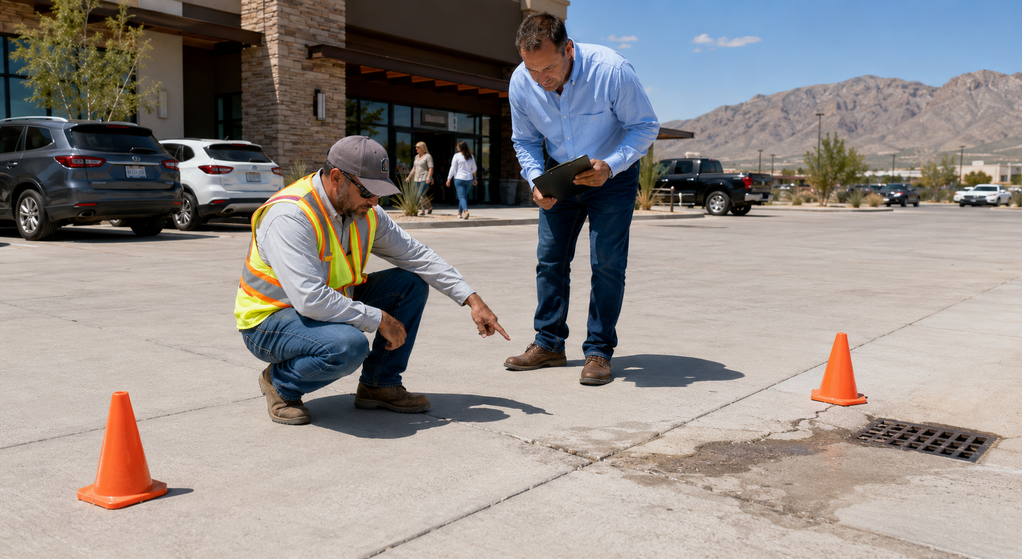
How to Prevent Concrete Parking Lot Problems on El Paso Properties
Key Takeaway
Most concrete parking lot problems in El Paso can be reduced through proper installation and consistent maintenance. Strong subgrade preparation, appropriate mix design, sealed joints, effective drainage, routine cleaning, and early crack repair help prevent small issues from becoming costly structural problems in the region’s heat and monsoon conditions.
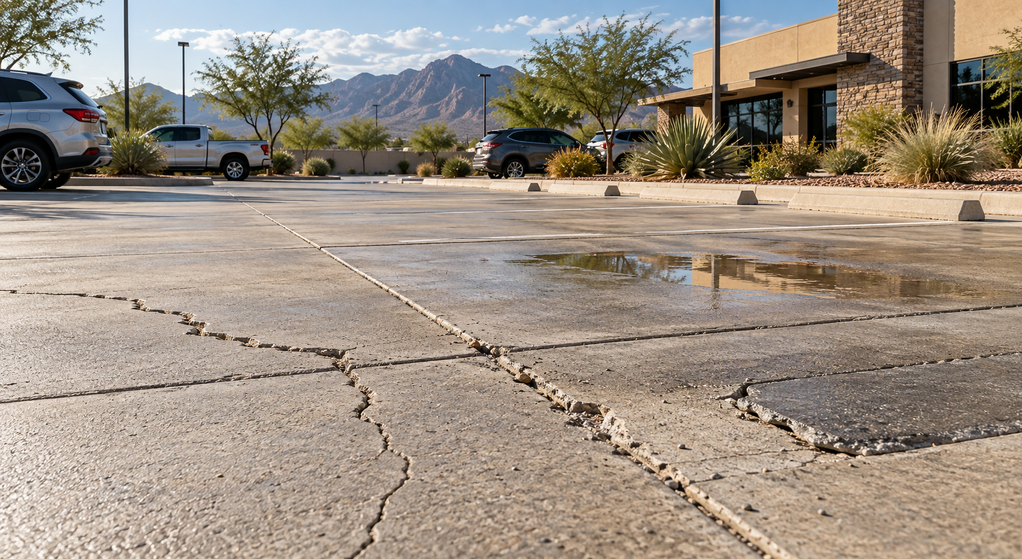
There is a common pattern in how parking lot problems develop on El Paso commercial properties. The lot looks fine for a few years. Small cracks appear and get noted but not addressed. The joint sealant starts to look worn and nobody schedules a resealing. A monsoon season leaves some areas with drainage issues that persist. And then, usually faster than the property owner expected, the lot is in a condition that requires significant repair rather than routine maintenance.
The frustrating part is that most of this is preventable. Not all concrete deterioration can be avoided — El Paso’s climate is genuinely hard on exterior surfaces, and some wear is simply the reality of maintaining a property in this environment. But the most expensive and disruptive parking lot problems that El Paso businesses deal with are almost always the result of either something done wrong at installation or something deferred too long in maintenance. Here is how to get ahead of both.
Start With the Right Installation
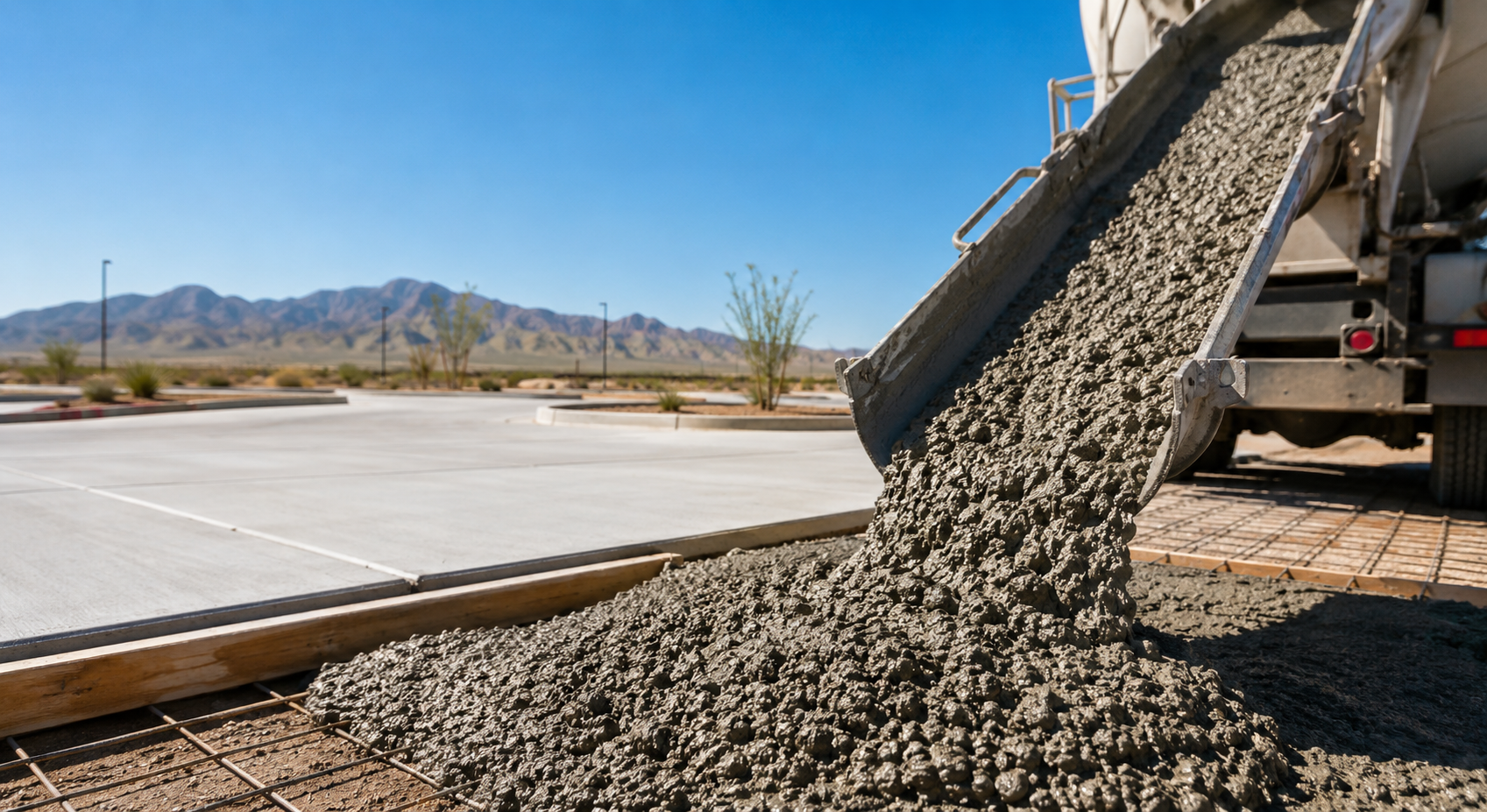
Prevention begins before a single yard of concrete is poured. The decisions made at the design and installation stage have more influence on a parking lot’s long-term condition than anything that happens afterward, and the installation shortcuts that seem like reasonable cost savings in the moment tend to produce the most expensive problems over time. For El Paso property owners investing in a new parking lot, partnering with a contractor experienced in concrete parking lot services in El Paso who treats the foundational decisions — mix design, subgrade preparation, joint spacing, curing protocol — as genuinely important rather than formalities is the most consequential prevention step available.
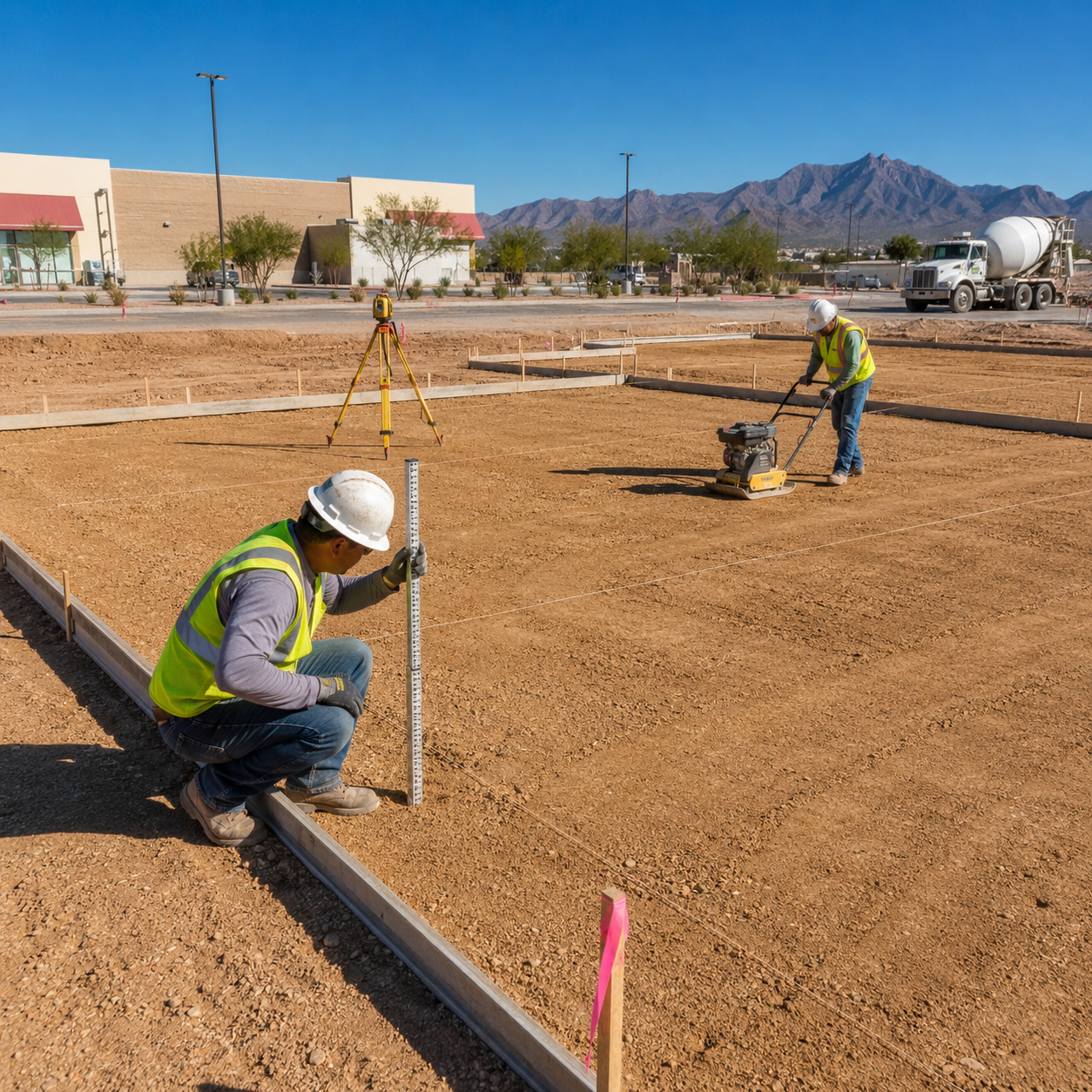
Subgrade preparation is where the most common installation shortcuts occur and where those shortcuts have the longest-lasting consequences. A subgrade that was not properly cleared of organic material, not compacted to consistent density, or not assessed for the caliche conditions that vary across El Paso’s geology produces a parking lot that settles unevenly over time, regardless of how well the concrete itself was placed. Differential settlement causes cracking and drainage problems that no amount of surface maintenance can prevent once the underlying subgrade movement is underway.
Mix design for El Paso’s conditions — a low water-to-cement ratio appropriate for the thermal cycling and UV exposure the lot will face, proper admixtures to manage workability in summer heat without adding excess water, and adequate compressive strength for the anticipated vehicle loads — produces a slab that starts its service life with the structural capacity to handle what El Paso’s environment will deliver. A mix that cuts corners on any of these parameters produces a lot that begins showing problems sooner than a properly specified one would.
Joint Sealing: The Highest-Return Maintenance Task
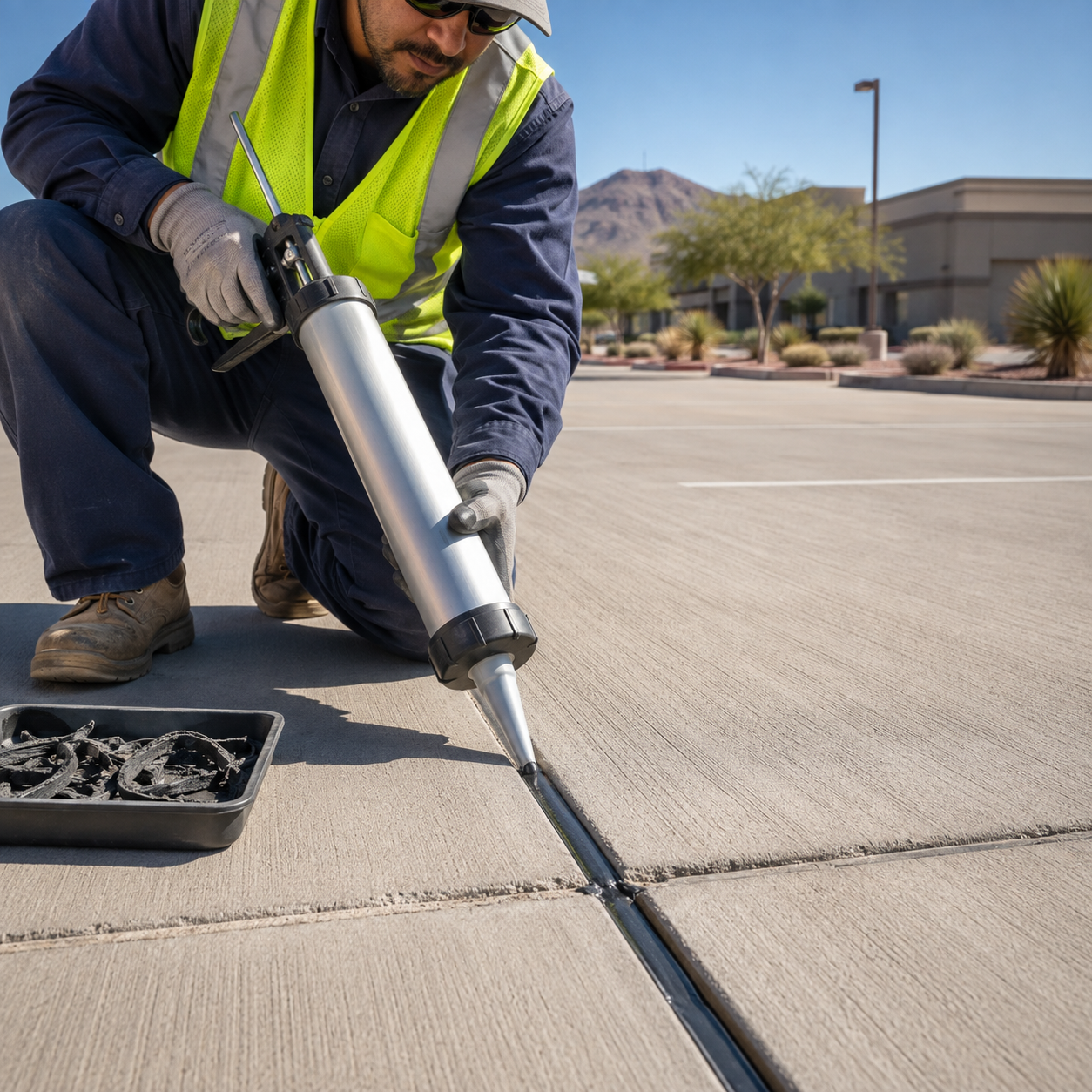
If there is a single maintenance task that prevents more parking lot problems in El Paso than any other, it is keeping the control joints properly sealed. Joints are the planned movement pathways in a concrete slab — they accommodate the thermal expansion and contraction that El Paso’s temperature range demands. When those joints are sealed, they function as designed. When the sealant fails and the joint is open, water infiltrates during monsoon events, debris compacts into the joint and forces the edges apart, and the concentrated moisture exposure accelerates deterioration at the joint edges and in the subbase beneath them.
In El Paso’s UV and temperature environment, joint sealant has a shorter effective life than in cooler or more humid markets. The UV radiation that exceeds what most mainland guide specifications assume, combined with the thermal expansion and contraction that the sealant must accommodate repeatedly across El Paso’s temperature range, degrades elastomeric sealants faster than their rated service life suggests. A resealing schedule calibrated to El Paso’s actual conditions — not to a generic national standard — keeps joints protected and is one of the lowest-cost, highest-return maintenance investments available for a parking lot in this market.
Surface Sealing Against Moisture and Contaminant Ingress
Surface sealing can help protect a concrete parking lot by reducing the amount of liquid water and dissolved contaminants that enter the concrete. In El Paso, this becomes particularly relevant during concentrated rain events, when standing water can remain on poorly drained areas and find its way into pores, joints, and existing cracks. Penetrating sealers such as silane- or siloxane-based products are designed primarily to reduce water absorption while allowing water vapor within the concrete to escape. Rather than protecting the concrete itself from UV degradation, their main value is limiting moisture and chloride ingress that can contribute to deterioration over time.
El Paso’s intense sunlight is still an important consideration, but its effects should be distinguished from moisture-related deterioration. Prolonged UV exposure can affect certain sealers, coatings, pigments, and decorative surface treatments, while high surface temperatures can contribute to thermal movement and place additional demands on joints and existing cracks. Exterior products should therefore be selected according to their intended exposure and manufacturer specifications.
At El Paso Concrete Contractors, maintenance recommendations for parking lot clients should account for the condition of the existing concrete, drainage patterns, surface exposure, traffic demands, and the type of protective treatment already in place. Sealing intervals should be based on the actual condition and performance of the surface rather than on the assumption that a penetrating sealer provides direct UV protection to the concrete matrix.
Surface sealing is also not a substitute for proper drainage, functioning joints, timely crack repair, and routine inspection. Used as part of a broader maintenance program, an appropriate penetrating sealer can help reduce water and contaminant penetration and support the long-term performance of an otherwise sound concrete parking lot.
Drainage Management After Every Rain Event
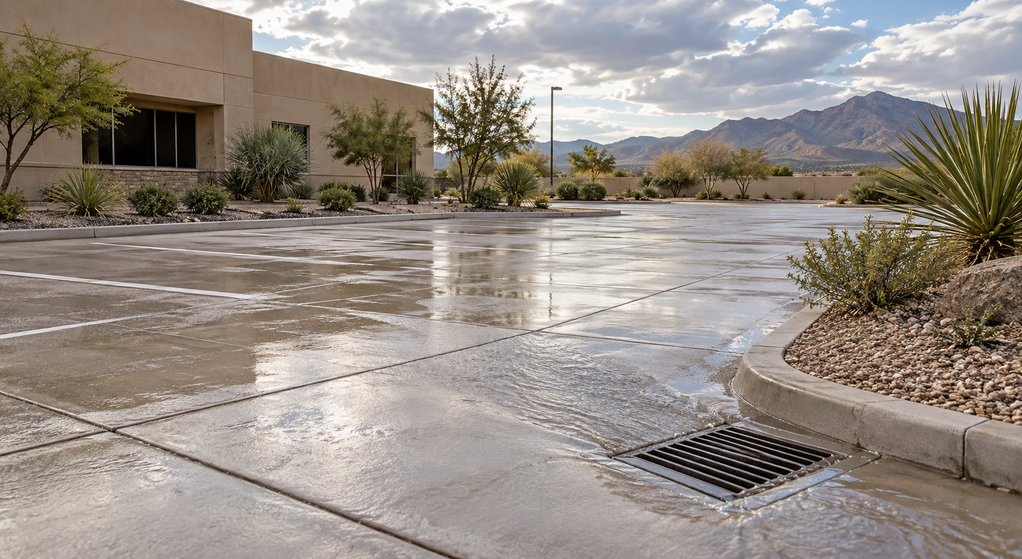
El Paso’s rainfall pattern — relatively dry most of the year with concentrated monsoon-season events that deliver significant water volume in short periods — creates a specific drainage challenge for parking lots. A lot that drains efficiently handles these events without lasting consequence. A lot with drainage problems, whether from original grade design that does not move water effectively or from settlement that has altered the original drainage pattern, accumulates standing water during monsoon events and then experiences the subbase saturation that follows as that water infiltrates through any joint or crack openings it finds.
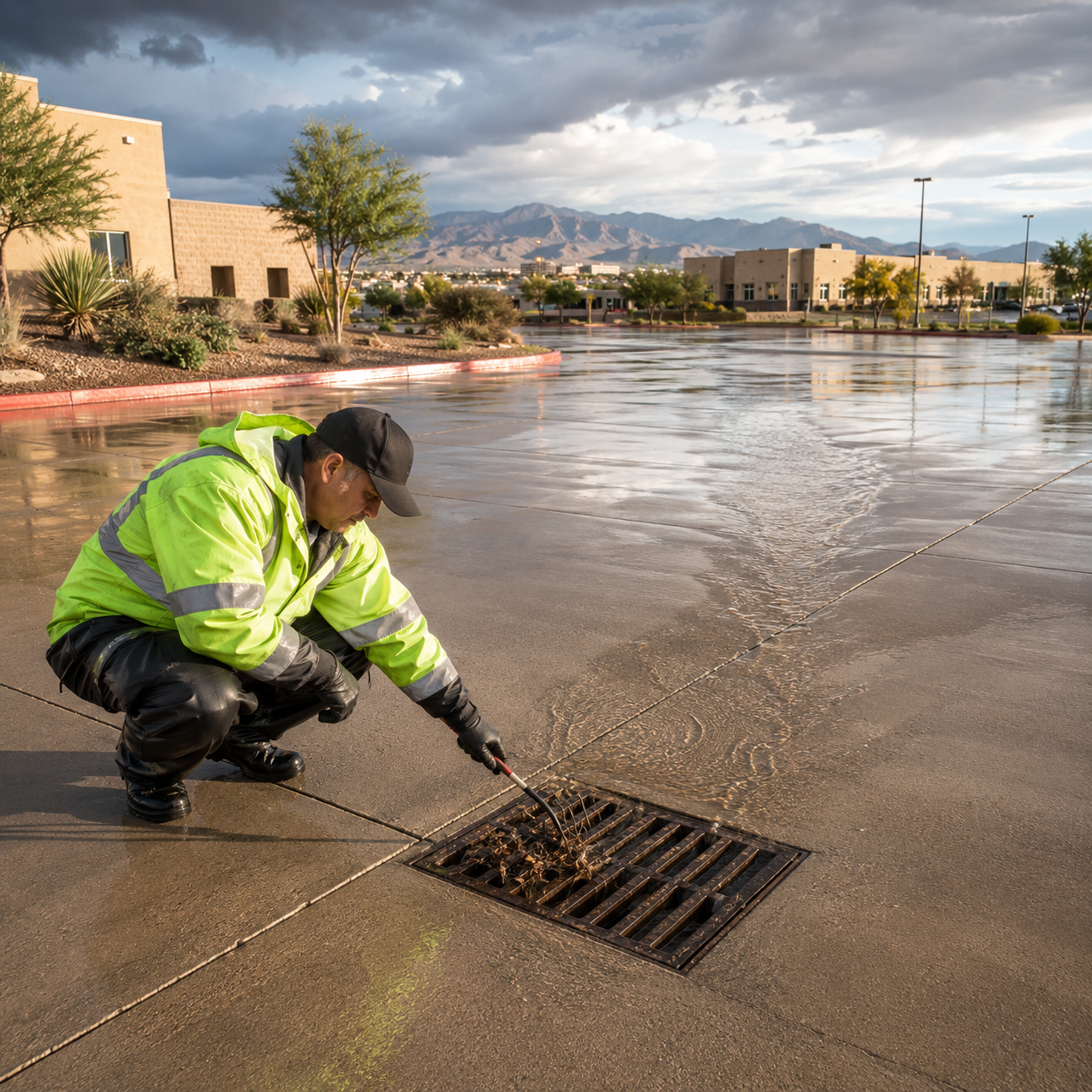
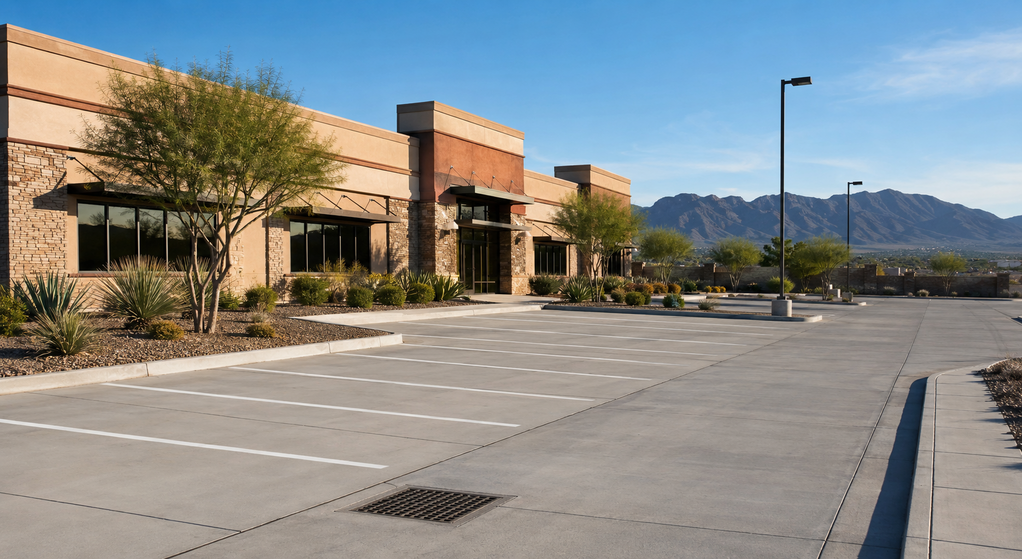
Preventing drainage problems starts with grade design at installation — ensuring the lot has adequate cross-slope to move water toward drains or off the lot edge, that no low spots are built into the grade profile, and that any drains are sized and located to handle the rainfall intensity El Paso’s monsoon events produce. Preventing drainage problems over the lot’s life means monitoring for any areas where settlement has created new low spots, keeping drain openings clear of debris, and sealing any joint or crack openings that could allow water to infiltrate rather than run off.
Cleaning: The Prevention Step Most Often Overlooked
Regular cleaning is one of the simplest parking lot maintenance steps, but it is also one of the most commonly neglected. Oil, fuel, dirt, tire residue, leaves, sediment, and other contaminants accumulate gradually and can make it harder to see developing cracks, joint deterioration, drainage problems, and surface wear.
Cleaning also matters when coatings, sealers, or surface treatments are part of the maintenance program. A contaminated surface can interfere with proper adhesion and reduce the effectiveness of products applied to protect or restore the concrete. Removing accumulated residue gives contractors a cleaner surface to inspect and prepare before additional maintenance work begins.
Just as importantly, cleaning creates an opportunity to notice problems while they are still localized. Cracks that are beginning to widen, low areas holding water, deteriorated joints, surface scaling, and other warning signs become easier to identify once dirt and stains are removed. Our article on common concrete parking lot problems for El Paso properties explains the types of deterioration property owners should watch for during routine inspections.
The goal is not to keep a commercial parking lot looking spotless at all times. It is to prevent contamination and neglect from hiding conditions that need attention. When regular cleaning is combined with inspection, joint maintenance, drainage management, and early repair, property owners have a better chance of addressing small issues before they develop into larger parking lot problems.
Building a Practical Prevention Program
The most effective prevention program for a concrete parking lot in El Paso is one that is realistic about the schedule it requires and specific about what El Paso’s conditions demand. That means joint inspection and resealing on a schedule calibrated to local UV and thermal conditions rather than a generic national standard. It means surface sealing before the original finish has degraded rather than after. It means cleaning on a frequency that prevents automotive fluid accumulation from reaching the level where it begins to affect the concrete. And it means prompt attention to any cracks or surface damage that appear, before they develop into problems that require more than routine maintenance to address.
A prevention program does not need to be complicated to be effective. The core elements are inspection, joint sealing, surface sealing, cleaning, and prompt crack attention. What makes it El Paso-specific is the frequency of each element and the product specifications used — both of which should reflect the actual UV exposure, thermal cycling, and drainage demands that El Paso properties experience rather than what a generic guide assumes about a mild or moderate climate.
For a detailed look at the specific maintenance practices that make the most meaningful difference for concrete in El Paso’s environment — including the steps that experienced contractors in this market prioritize over generic recommendations — our article on maintaining concrete in El Paso’s dry, hot conditions covers exactly that, and is a practical companion to the prevention principles outlined here.
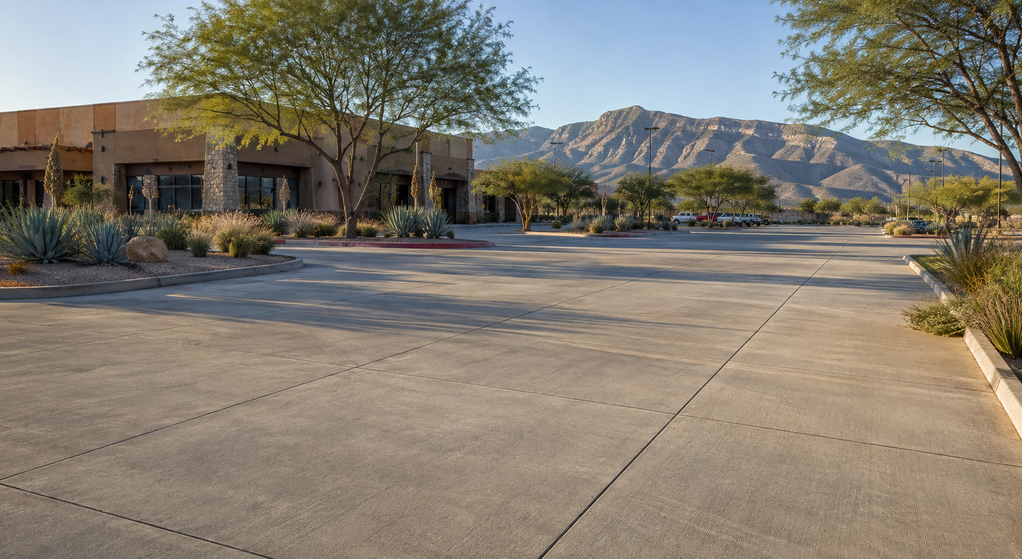
Most of the concrete parking lot problems that El Paso property owners deal with were preventable. The ones that were not are the minority. Getting the installation right and maintaining the surface consistently are the two things that most reliably determine which category a given lot ends up in.

Written By:
Kurt Manalastas
Home & Property Research Journalist
Kurt is a Home & Property Research Journalist who creates educational content on home services, property improvement, and residential decision-making. He translates contractor experience, industry standards, and verified research into clear, practical guidance that helps homeowners understand their options and make informed decisions.