How Poor Drainage Can Damage Concrete Parking Lots in El Paso
Key Takeaway:
Poor drainage is an underestimated cause of concrete parking lot damage in El Paso, TX. Even in a dry climate, water that pools, enters joints, or saturates the subgrade can lead to cracking, settlement, and surface deterioration. Addressing drainage early is usually less expensive than repairing the concrete damage that develops when it is ignored.
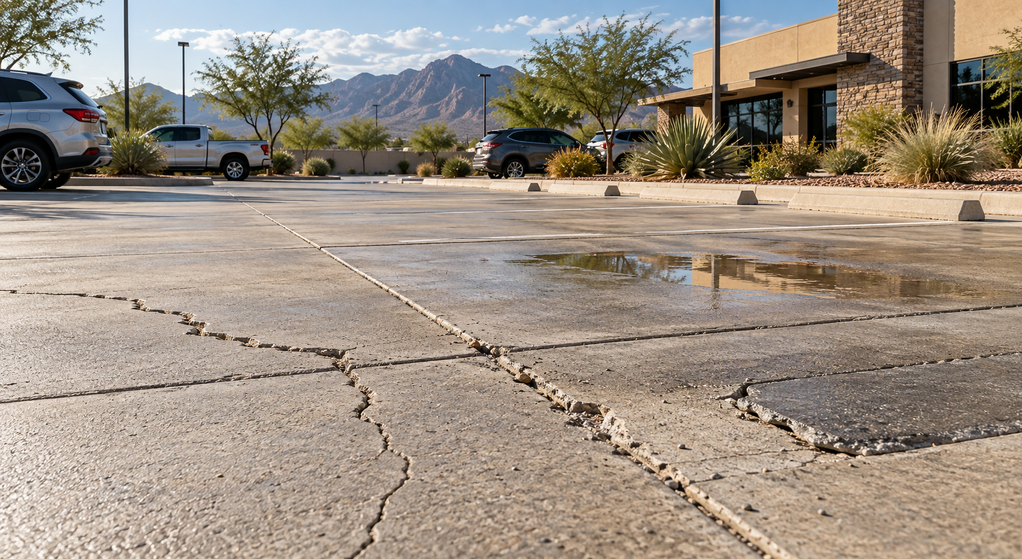
El Paso is not what most people picture when they think of drainage problems. El Paso is a desert city with low annual rainfall, frequent sun, and conditions where water usually does not linger for long. But anyone who has watched an El Paso monsoon roll through in July or August knows that when the water comes, it comes fast and hard. And for a concrete parking lot without adequate drainage, that brief but intense rainfall is enough to set in motion a chain of damage that takes months or years to fully reveal itself.
Drainage is one of the most overlooked aspects of parking lot design and maintenance in El Paso. It does not get the same attention as surface finish or crack repair, but it is often the root cause behind both of those problems. Here is how poor drainage actually damages concrete parking lots in this climate, and what property owners should understand before deciding how to respond.
Why Drainage Matters Even in a Desert Climate
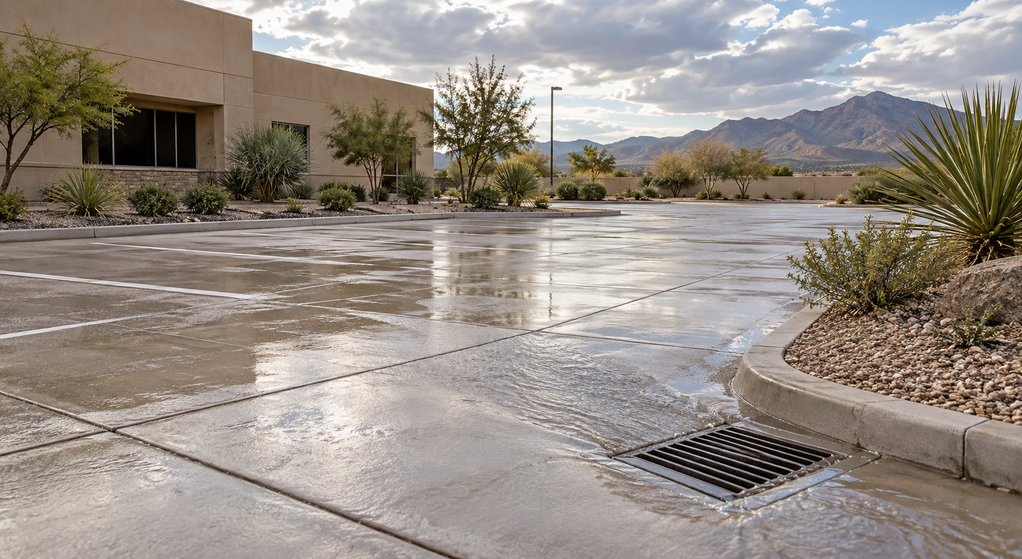
The assumption that El Paso’s dry climate makes drainage a low priority is one of the more expensive misconceptions that commercial property owners in the area encounter. The issue is not average annual rainfall; it is the intensity of the storms that do occur. El Paso’s summer monsoon season brings storms that can drop significant rainfall in a short period, generating runoff faster than unprepared surfaces and subgrades can handle it. A parking lot without adequate slope, without functional drainage infrastructure, or with failed joint sealant that allows water infiltration is at risk during every one of those events. Professional concrete parking lot services in El Paso address drainage as part of the initial design rather than as an afterthought, because the cost of building drainage correctly into a new installation is a fraction of what it costs to remediate the structural problems that poor drainage produces over time.
The dry conditions between rainfall events also contribute to the drainage problem in ways that are less obvious. El Paso’s heat and low humidity cause the soil beneath concrete slabs to dry out and contract during extended dry periods. When a significant rain event follows a long dry period — which is exactly the pattern that El Paso’s monsoon season produces — that dry, contracted soil initially sheds water rather than absorbing it, and water that might otherwise soak in relatively harmlessly instead moves across and beneath the parking lot surface, finding any pathway it can into the subgrade.
How Water Gets Into the Subgrade
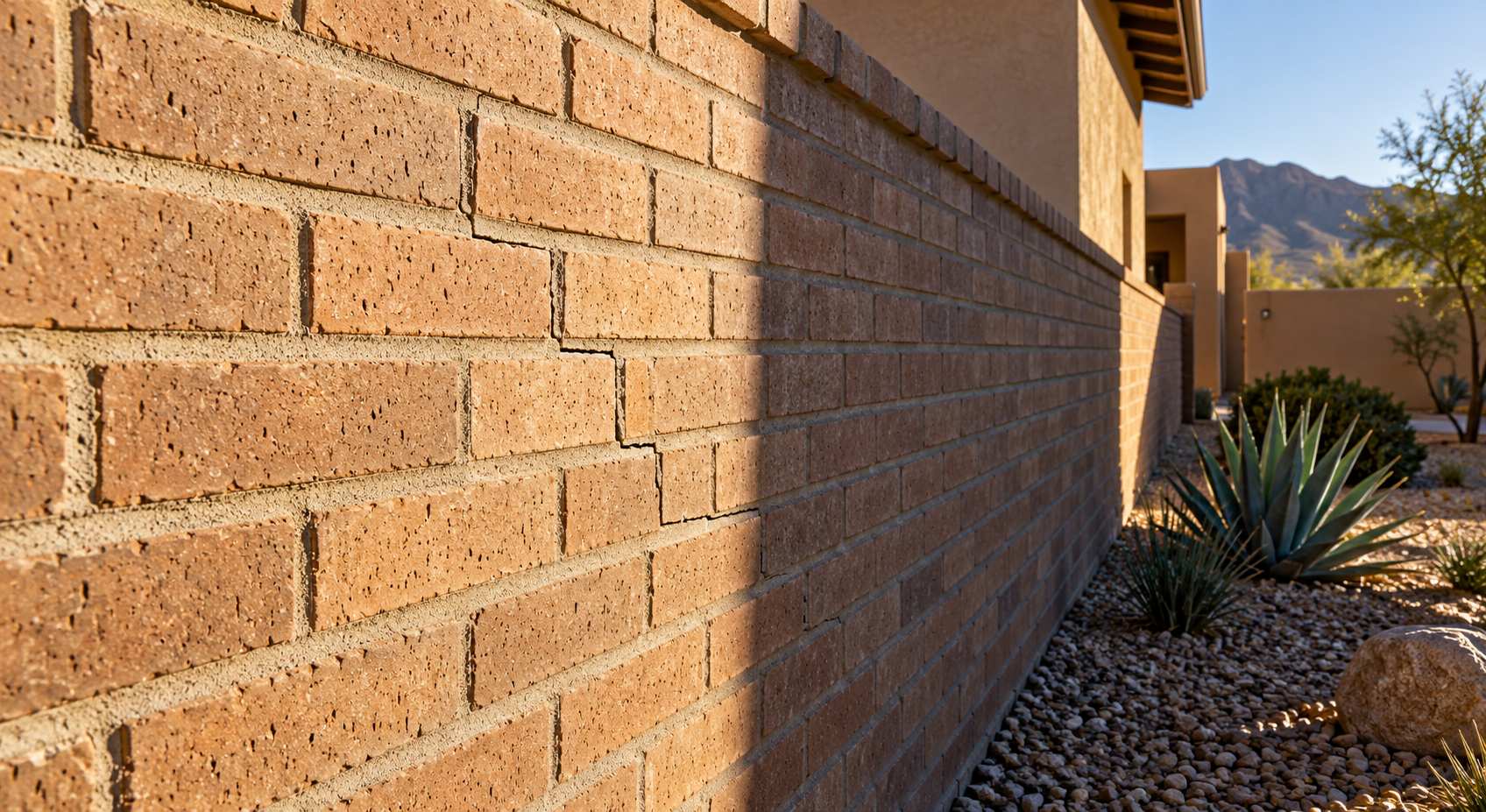
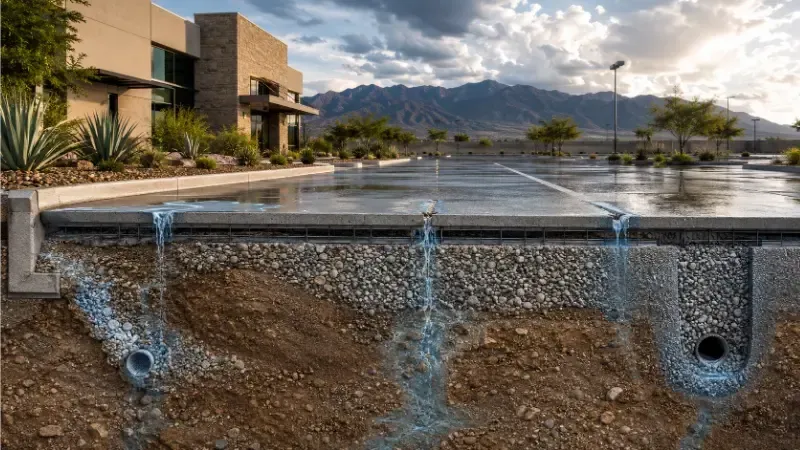
Understanding how water reaches the subgrade beneath a concrete parking lot clarifies why drainage design is so consequential for long-term performance. The most direct pathway is through failed or open joints and cracks. A parking lot with deteriorated joint sealant, even one with relatively few visible surface cracks, is essentially open to water infiltration at every joint line. During a heavy rain event, water standing on the parking lot surface finds those open joints and works directly into the subgrade below.
Edge infiltration is another common pathway that property owners often miss. Where the parking lot surface meets landscaped areas, curbs, or other adjacent surfaces, water that runs off the lot or collects near the perimeter can work its way beneath the slab along that edge. In El Paso, where landscaping irrigation is common, the combination of monsoon rain events and regular irrigation near the parking lot perimeter creates a chronic moisture exposure at the slab edges that is more significant than the rainfall alone would suggest.
Low spots in the parking lot surface — created by original grade deficiencies or by settlement over time — are the third major pathway. Water that ponds in a low spot has time to find every available infiltration point rather than draining off the surface quickly as properly graded concrete would. The longer water sits, the more it works into any crack or joint it contacts, and in El Paso’s heat, the evaporation cycle that follows repeated ponding events concentrates dissolved minerals in the concrete that contribute to surface scaling and deterioration.
What Happens to the Subgrade When It Gets Wet
Once water reaches the subgrade beneath a concrete parking lot, the damage mechanism begins. The subgrade — the compacted soil and aggregate base that supports the slab — depends on its density and stability to provide uniform support for the concrete above. When water saturates that material, it reduces its bearing capacity. The slab above it flexes under vehicle loads in ways it was not designed to handle, and that flexing produces the cracking that property owners eventually notice on the surface.
The erosion process is the other major consequence of water in the subgrade. In El Paso’s soil conditions, which include both clay and sandy components depending on location, water moving through the subgrade can carry fine particles away from beneath the slab. Over time, this creates voids — unsupported sections of slab that span an empty space beneath them. Those sections flex and crack under vehicle loads, and eventually they may develop the slab settlement that creates visible unevenness and trip hazards on the parking lot surface.
Recognizing subgrade problems early is important because the repair options narrow as the damage progresses. A subgrade that has been compromised by repeated water infiltration but has not yet developed significant voids can sometimes be stabilized through foam injection or other subgrade treatment approaches. A slab with significant voids and advanced settlement may require more extensive intervention. At
El Paso Concrete Contractors, we assess subgrade condition as part of every parking lot evaluation, because the visible surface damage is often a downstream indicator of a subgrade problem that needs to be addressed for any repair to hold long-term.
Surface Damage Caused by Poor Drainage
The concrete surface itself also deteriorates faster in areas with drainage problems, even setting aside the subgrade effects. Repeated ponding and evaporation cycles concentrate dissolved salts and minerals at the concrete surface and just below it, contributing to surface scaling that gives the concrete a rough, flaking appearance. The same cycle promotes the growth of algae and moss in shaded areas where moisture lingers, and biological growth that retains moisture against the concrete surface accelerates deterioration at those contact points.
Joints that are chronically wet from poor drainage experience accelerated sealant deterioration, creating a self-reinforcing cycle where poor drainage degrades the joint sealant, open joints allow more water infiltration, and the resulting subgrade saturation causes additional damage to both the concrete and the joints themselves. This pattern is one of the more reliable indicators that a parking lot’s drainage design or drainage infrastructure needs attention, because the joint deterioration rate accelerates visibly once this cycle is established.
Correcting Drainage Problems: What the Options Look Like
The right response depends on where the drainage problem starts. Drainage issues that originate from the original grade design — insufficient slope to move water to drains or off the lot — are the most difficult and expensive to correct after construction because they require either grinding the slab surface to create better slope, adding drainage infrastructure, or in some cases partial replacement of the affected sections. Drainage problems that originate from failed joint sealant are among the least expensive to correct — resealing joints is a routine maintenance task that prevents the downstream damage described above.
Low spots created by settlement can sometimes be addressed through slab leveling, which raises the settled section back toward its original elevation and restores the slope that directs water off the surface. The viability of leveling depends on whether the subgrade beneath the settled section is stable enough to support the raised slab, which is something that requires professional assessment rather than a decision made based on the surface appearance alone.
Prevention: Building Drainage In From the Start
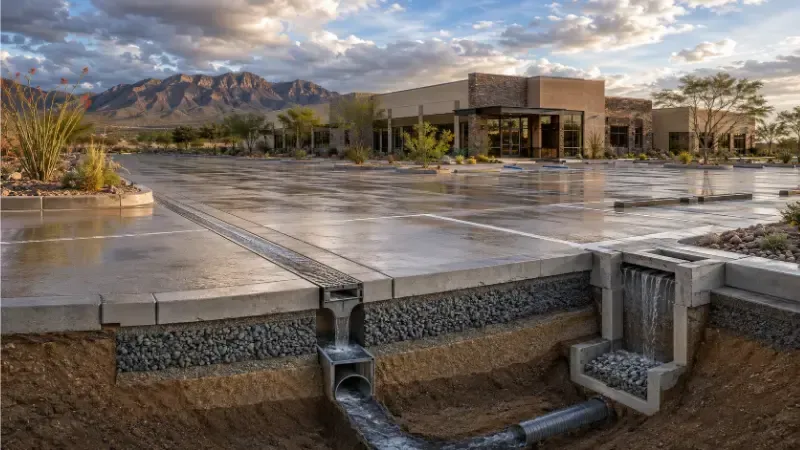
For parking lots being designed or replaced, building drainage in from the start is always more cost-effective than correcting it after the fact. Adequate slope — generally a minimum of one to two percent across the parking lot surface — moves water toward drains or off the lot perimeter rather than allowing it to pond. Drains positioned at low points in the grade collect water before it can sit on the surface and infiltrate through joints or cracks. Edge conditions that separate the concrete from irrigated landscaping reduce the chronic moisture exposure that causes accelerated edge deterioration.
Quality joint sealant applied at installation and maintained on a regular inspection and reapplication schedule keeps the most direct water infiltration pathway closed throughout the lot’s service life. In El Paso’s UV environment, joint sealant degrades faster than in milder climates, which means the inspection interval appropriate for a more temperate market may not be adequate for El Paso conditions. Building a maintenance schedule that reflects the actual UV and rainfall exposure of the specific property produces better outcomes than applying a generic maintenance schedule regardless of local conditions.
Understanding how grading, slope, and surface accuracy prevent water from ponding is useful context alongside the drainage issues covered here. Our article on
how precision grading and laser-leveling prevent expensive concrete failures in El Paso explains how proper surface preparation helps reduce low spots, runoff problems, and premature concrete failure.

Written By:
Domenique Bomediano
Home Improvement Research Specialist
Domenique Jose Bomediano develops research-based educational content on home renovation, construction, concrete services, and property improvement. He breaks down technical concepts, contractor insights, and industry standards into practical, easy-to-understand information that helps homeowners evaluate projects, estimate costs, and make informed long-term property decisions.