When Concrete Parking Lot Repair in El Paso Is Not Enough
Decision Guide
Repair is right for most concrete parking lot problems in El Paso, but not every case. When structural failure is too advanced for targeted repairs, or repeated repair costs approach replacement cost, full replacement may offer better long-term value. Knowing the difference before approving a repair scope helps business owners avoid wasted money, downtime, and recurring damage.
Repair is almost always the first instinct when a parking lot starts showing serious problems. It makes sense on the surface — repair is less disruptive, less expensive upfront, and easier to schedule around a business’s operations. But repair is not always the right answer, and for parking lots in El Paso that have reached a certain threshold of deterioration, continuing to repair rather than replace is one of those decisions that looks financially prudent in the short term and costs more in the long run.
Understanding when repair genuinely addresses the problem versus when it is buying time against an inevitable replacement is one of the more useful distinctions a business owner or property manager can make. El Paso’s specific climate and soil conditions — intense heat, caliche subgrade, and monsoon-driven drainage stress — create failure patterns that make this distinction more consequential than in markets with more forgiving conditions. Here is how to think through it.
What Repair Can and Cannot Accomplish
Concrete parking lot repair addresses specific, localized problems: crack filling, joint resealing, spall patching, surface restoration in sections where the underlying slab is still structurally sound. Done correctly, these repairs extend the serviceable life of a parking lot significantly and prevent isolated problems from developing into wholesale failure. For El Paso businesses managing properties where the overall slab condition is still fundamentally intact and the damage is concentrated in specific areas or driven by identifiable causes that can be addressed, professional concrete parking lot services in El Paso deliver real value and real results. Repair becomes inadequate when the problems are no longer localized, when the structural integrity of the slab has been compromised in ways that surface-level intervention cannot restore, or when the root cause of the damage cannot be corrected without removing and replacing the affected section entirely.
The most important thing to understand about concrete repair is that it works on the concrete — not necessarily on whatever caused the concrete to fail. A patch fills a crack or spalled area, but if the subgrade beneath that area has settled, eroded, or lost its bearing capacity, the patch is sitting on the same compromised foundation as the original concrete. In El Paso, where caliche behavior and drainage issues frequently drive subgrade problems that then manifest at the surface, this distinction matters a great deal. Repair that does not account for what is happening beneath the slab tends to fail earlier than the original concrete did in the same location.

Structural Failure: When the Slab Itself Is Compromised
There is a meaningful difference between surface deterioration and structural failure, and the treatment for each is fundamentally different. Surface deterioration — scaling, spalling, surface cracking, joint failure — affects the condition of the concrete but not necessarily its load-bearing integrity. A parking lot with surface deterioration is often still doing its structural job; it just needs restoration of the surface layer that protects the concrete beneath it.
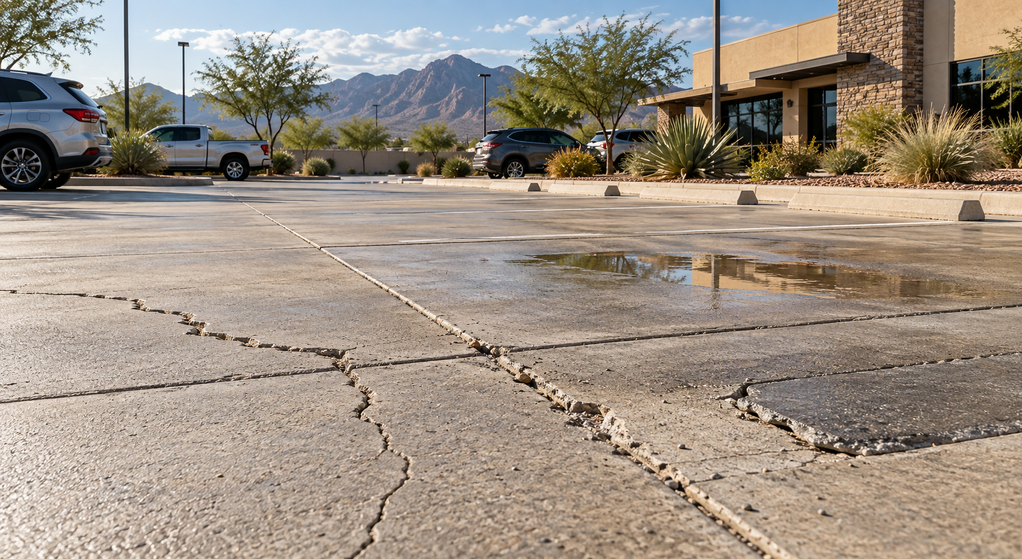
Structural failure is a different situation. When cracking has progressed to the point where sections of the slab have displaced significantly relative to adjacent sections, when hollow-sounding areas under vehicle load indicate voids in the subgrade beneath the slab, when the crack network is so extensive that it has effectively divided the slab into a collection of loose sections rather than a continuous load-distributing structure — at that point, repair is addressing symptoms of a system that has already failed. Patching individual cracks in a structurally failed section does not restore the section’s structural continuity. It makes it look better until it fails again.
El Paso’s caliche-rich subgrade creates a specific version of this problem. Caliche can provide good bearing capacity when it is intact and properly prepared, but it can also create unpredictable conditions when it is disturbed, when water infiltration changes its behavior, or when the caliche layer is uneven across a lot’s footprint and provides dramatically different support in adjacent areas. A parking lot where the caliche subgrade has been compromised — whether through drainage infiltration from failed joints, disturbance from utility work, or simply the long-term effect of heavy vehicle loads on a subgrade that was not adequately prepared at installation — is a parking lot where surface repair will not solve the underlying problem.
The Cumulative Cost Calculation
There is a financial argument for replacement that sometimes gets overlooked in the moment because individual repair invoices feel smaller than a replacement quote. But repair costs compound over time, and a parking lot that requires significant repair every two or three years is accumulating cost in ways that add up faster than the single larger number of a replacement project makes visible.
A useful calculation is to look at what has been spent on repairs over the past five years and project that forward. If the repair history shows escalating cost — each repair project larger than the last, more sections affected each time, the interval between repairs shortening — that trend line typically means replacement is coming regardless of whether it is chosen proactively or reactively.

Choosing it proactively, before the lot has deteriorated to the point of creating safety issues or severely affecting the impression the property makes, is almost always the more cost-controlled path.
Business disruption is also part of the calculation. A phased repair approach that keeps a portion of the parking lot out of service for weeks at a time across multiple repair projects over several years represents a cumulative operational cost in customer inconvenience and reduced access that a single, well-executed replacement project — planned and executed to minimize business disruption — does not produce to the same degree.
At El Paso Concrete Contractors, we walk business owners through this full picture when a parking lot is approaching the threshold where replacement deserves serious consideration, because the right recommendation is the one that actually serves the client’s long-term interest — not the one that generates the next repair invoice.
Drainage Problems That Repair Cannot Fix
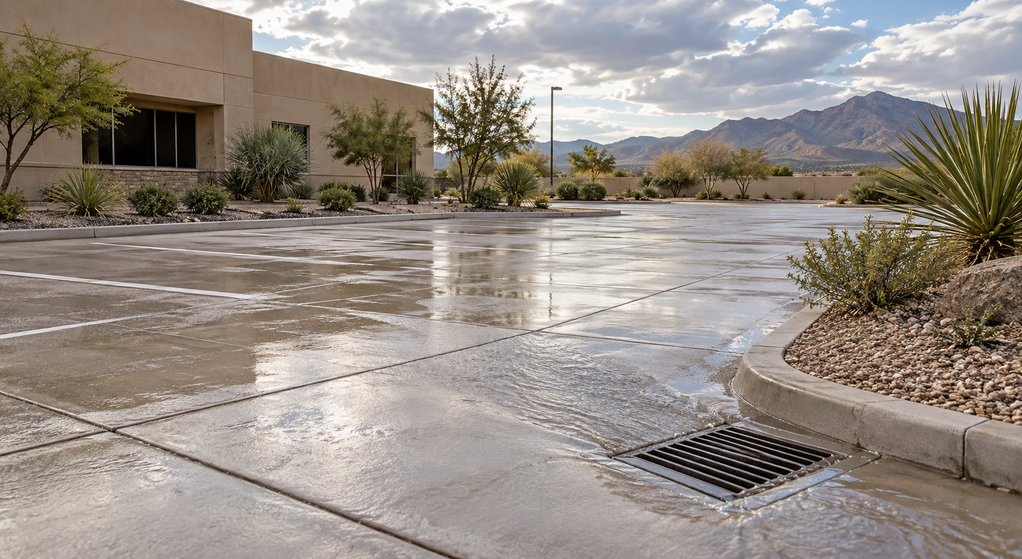
Some of the most persistent parking lot problems in El Paso trace back to drainage design that was inadequate at the time of original installation. A parking lot that was graded with insufficient slope to move water toward drains, or that has low points where water consistently pools after El Paso’s monsoon events, has a drainage problem that is baked into the lot’s geometry. Surface repairs can address the damage that poor drainage causes — the subbase erosion, the accelerated cracking in consistently wet areas, the joint deterioration at pooling points — but they cannot change the grade that is directing water to those areas in the first place.
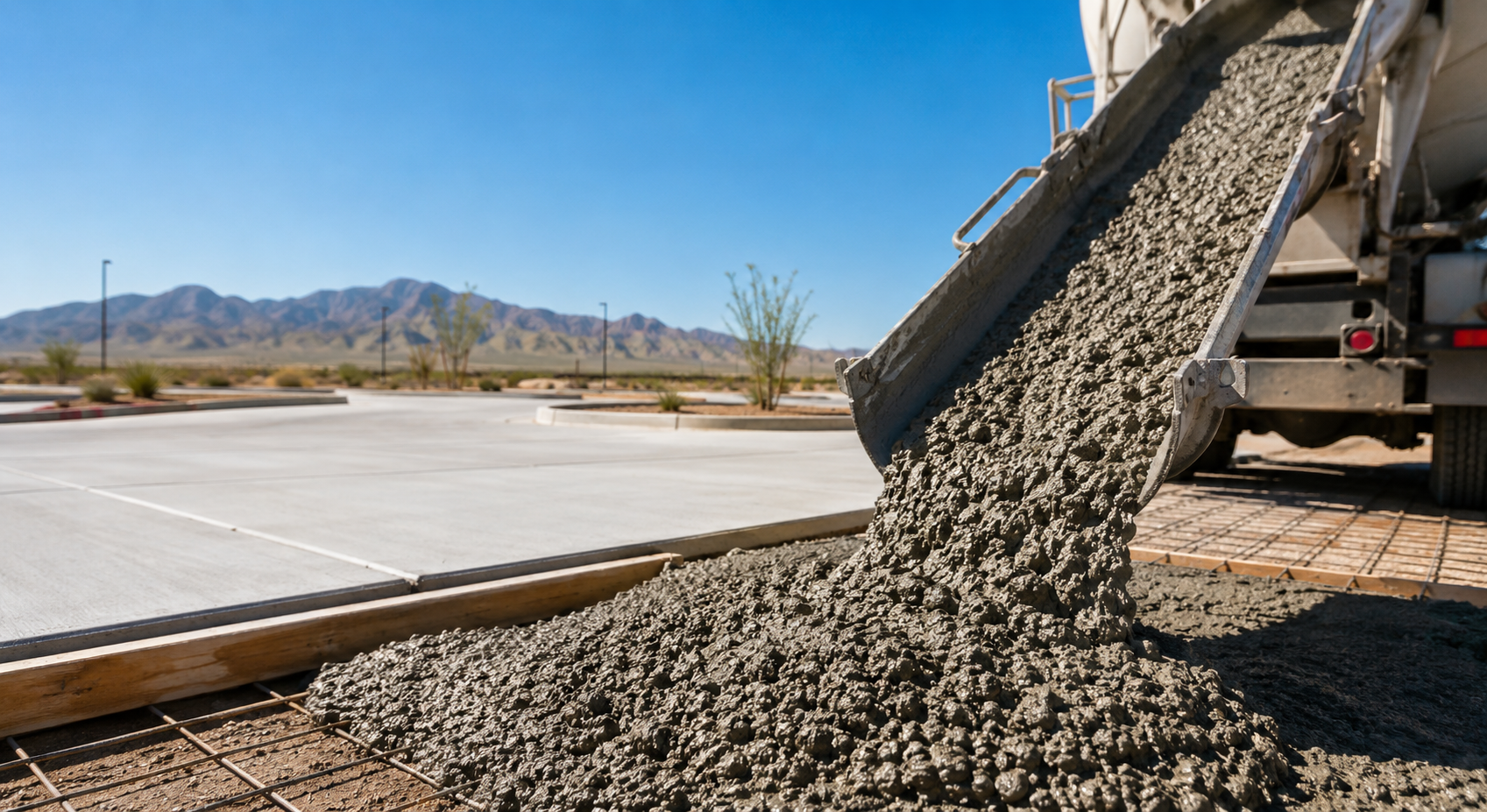
When drainage problems are the primary driver of a parking lot’s deterioration, and when those problems originate from the lot’s grade rather than from failed joints or insufficient drain maintenance, the only repair that actually addresses the cause is regrading — which in a concrete lot typically means removing the affected sections, correcting the subgrade grade, and pouring new concrete at the corrected elevation. That is, effectively, partial or full replacement. Recognizing this early, rather than after several rounds of surface repair that failed to slow the deterioration, is what separates a well-managed property from one where the same money gets spent twice.
Age, Load History, and the End of a Parking Lot’s Service Life
Concrete parking lots do not fail because of age alone. Their useful life is shaped by the original design, slab thickness, subgrade preparation, drainage, maintenance history, traffic patterns, and the loads they have carried over time.
A lot originally designed for passenger vehicles may deteriorate faster if it has spent years supporting delivery trucks, heavy equipment, or repeated concentrated loads. Likewise, a parking lot installed over poorly prepared soil or built without adequate drainage may begin developing settlement, cracking, joint movement, or recurring surface problems long before another lot of the same age.
These problems become more significant when several begin appearing at the same time. Widespread cracking, repeated patch failures, low areas that continue to collect water, settlement across multiple sections, and deteriorated joints can indicate that the parking lot is moving beyond isolated repair needs. Our guide to common concrete parking lot problems for El Paso properties provides additional context on these failure patterns and what they can reveal about the condition of the overall lot.
When age, accumulated loading, inadequate original construction, and recurring deterioration begin working together, replacement may provide better long-term value than continuing to repair individual symptoms. A new parking lot can then be designed around the property’s actual traffic, El Paso’s soil conditions, drainage requirements, and expected service demands instead of continuing to work around limitations built into the existing slab.The repair-versus-replacement decision should therefore consider the parking lot as a complete system—not simply the number of visible cracks or the age of the concrete.
Making the Right Call
The repair-versus-replacement decision for a concrete parking lot in El Paso is not based on one fixed formula. It depends on the condition of the slab, the supporting base and subgrade, the history of the damage, drainage performance, and the property owner's long-term plans. Sometimes repair is the right investment. In other cases, repeated repairs simply postpone replacement while costs continue to accumulate.
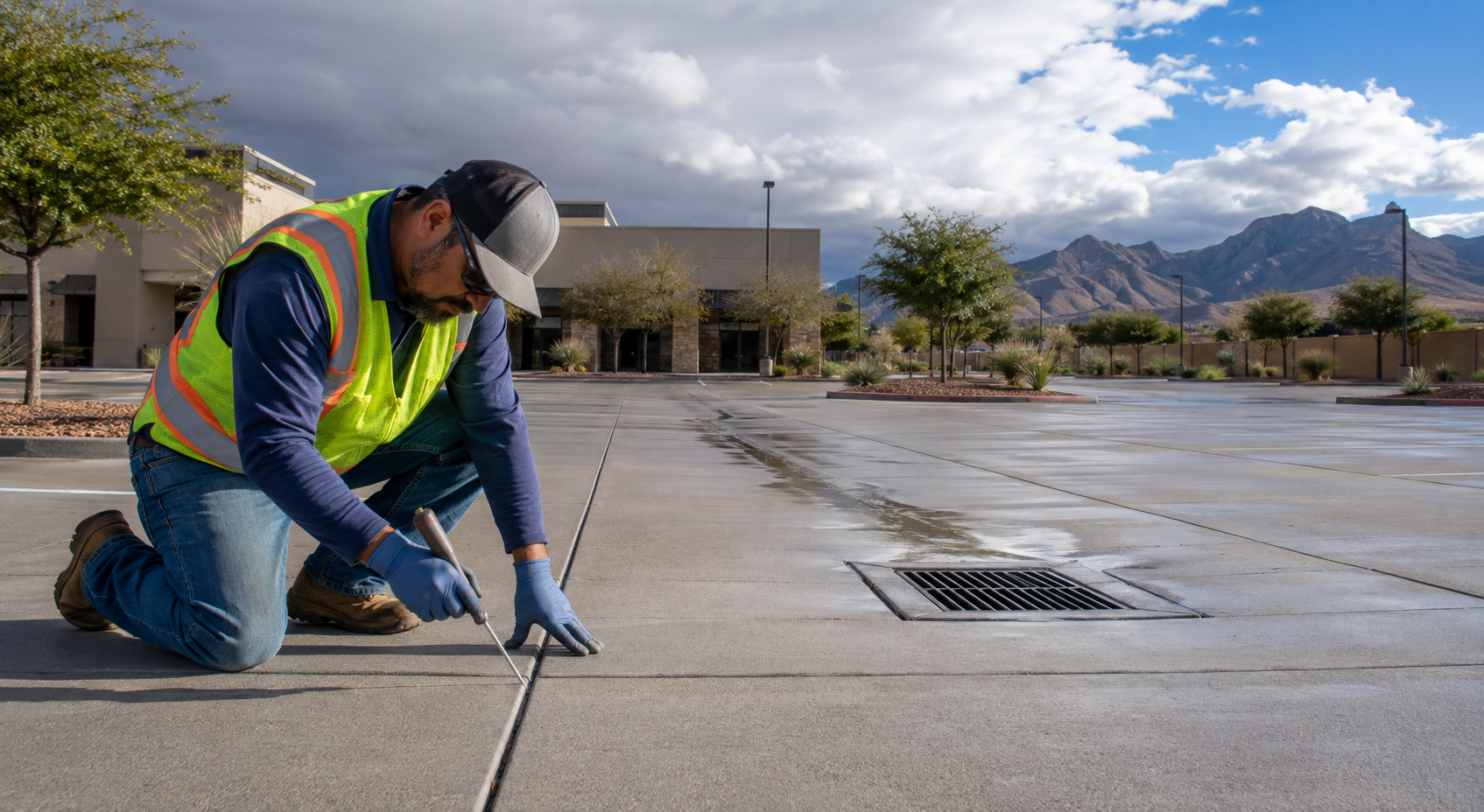
The most useful step is a thorough assessment of the entire parking lot rather than relying only on visible surface damage. Contractors may evaluate cracking patterns, settlement, joint movement, drainage behavior, and hollow-sounding areas that can indicate voids or delamination. Tap testing can help identify some of these conditions, but determining what is happening beneath the slab may require additional investigation when recurring cracking or settlement suggests a deeper support problem.

For parking lots that remain structurally repairable, maintaining concrete in maintaining concrete in El Paso’s dry, hot conditions can help property owners understand the maintenance practices that extend service life and reduce the likelihood of premature deterioration.
Repair is not always wrong, and replacement is not always necessary. The right decision depends on whether the damage is localized and correctable or whether broader problems with the slab, drainage, or supporting conditions make continued repair an increasingly temporary solution.

Written By:
Kurt Manalastas
Home & Property Research Journalist
Kurt is a Home & Property Research Journalist who creates educational content on home services, property improvement, and residential decision-making. He translates contractor experience, industry standards, and verified research into clear, practical guidance that helps homeowners understand their options and make informed decisions.